Andorra raises many questions: what exactly it is, whether it ever belonged to Spain, who it belongs to today, or when it became independent. And that is not surprising, because its political history is one of the most unique in Europe. Andorra is an independent State, located between Spain and France, with a very particular institutional form: a parliamentary co-principality. Its evolution does not fully fit the classic pattern of “it became independent from X country on such date”, and that is precisely the key to understanding its history.
Andorra is an independent country; its official name is Principat d’Andorra.
The co-princes are the heads of state, but Andorra functions as a parliamentary democracy.
It did not become independent from Spain on a specific date like other modern States.
In 1993, it adopted its modern Constitution, which defines it as an independent, democratic, social State governed by the rule of law.
What exactly is Andorra?
Andorra is a European microstate located in the Pyrenees, between Spain and France. Its official name is Principat d’Andorra and its current political system is a parliamentary co-principality. This means that it has two co-princes as heads of state, while sovereignty resides in the Andorran people and is articulated through the institutions established by its Constitution.
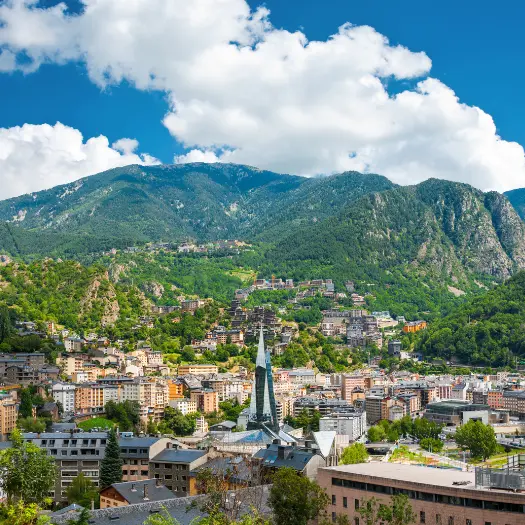
Andorra is not a region of Spain or France; it is an independent State with its own institutional tradition.
Who does Andorra belong to?
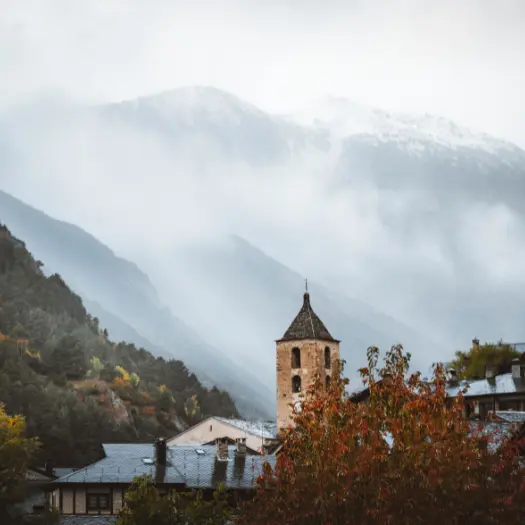
The short answer is: Andorra does not belong to Spain or France. It is a sovereign country. However, its history explains why many people ask that question. For centuries, Andorra had a political organisation based on shared sovereignty between the Bishop of Urgell and the Count of Foix, which gave rise to the institution of the co-princes. Over time, that formula evolved into the current model.
Today, the co-princes are the Bishop of Urgell and the President of the French Republic, but that does not mean that Andorra belongs to Spain or France. It means that its headship of state preserves its own historical institution, compatible with its status as an independent and democratic State.
Put very clearly: Andorra does not “belong to anyone”; Andorra is Andorra. Its modern independence is constitutionally recognised and also internationally, for example through its admission to the UN in 1993.
History of Andorra: from medieval origins to the current State
The political history of Andorra is often poorly summarised. It is not well understood if one looks for a classic “independence”, because its trajectory is more medieval and institutional than revolutionary. According to the official history of the Govern d’Andorra, in the 13th century disputes between the Bishop of Urgell and the Count of Foix ended with the signing of the Paréages of 1278 and 1288. The first laid the foundations for shared sovereignty and the birth of the Principality.
From there comes one of the key positioning ideas for this article: Andorra did not emerge as a former colony or as a territory separated from Spain, but rather as a Pyrenean political reality with a formula of shared sovereignty that allowed it to preserve historical continuity.
For centuries, that feudal and institutional system remained in place. Britannica summarises that the traditional system continued until 1993, when a Constitution was adopted that transferred most political powers to Andorra’s democratic institutions.
| Date | Milestone | Why it matters |
|---|---|---|
| 1278 | First Paréage | It establishes shared sovereignty and the origin of the Principality. |
| 1288 | Second Paréage | It consolidates Andorra’s medieval political framework. |
| 1993 | Constitution of Andorra | It defines Andorra as an independent, democratic and social State. |
| 1993 | Admission to the UN | It strengthens its international recognition as a sovereign State. |
| 1994 | Entry into the Council of Europe | It reinforces its European institutional integration. |
When did Andorra become independent?
Andorra did not become independent from Spain on a specific date; its political origin dates back to 1278, and its modern constitutional framework was established in 1993.
Was Andorra part of Spain?
No. Andorra was not “Spain”. Its history is closely linked to the Catalan area and to institutions connected to the bishopric of Urgell, but that does not mean it was integrated as part of the contemporary Spanish State. Britannica does, in fact, point out its historical affinity with Catalonia, while Andorran sources highlight its own institutional evolution.
Andorra has maintained a distinct political identity for centuries, although historically it has been closely linked to the Catalan, Spanish and French environment.
Why is Andorra an independent country?
Because it has the basic elements of a State: its own constitutional order, its own institutions, recognised sovereignty, and international legal personality. Its Constitution explicitly states that it is an independent State, and its admission to the UN in 1993 confirms that recognition internationally.
FAQs about Andorra, its history and its independence
Is Andorra a country?
Yes. The Andorran Constitution defines it as an independent, democratic and social State governed by the rule of law.
Is Andorra a country?
Yes. The Andorran Constitution defines it as an independent, democratic and social State governed by the rule of law.
Which State does Andorra belong to?
To none. It belongs neither to Spain nor to France; it is a sovereign State with a shared headship of state by historical tradition.
When did Andorra become independent?
There is no independence date from Spain as such. The key dates are 1278, for the origin of the Principality, and 1993, for its modern Constitution.
Was Andorra part of Spain?
No, not in the sense of having been a modern Spanish province or autonomous community. Its historical trajectory was its own, although very closely linked to the Catalan environment.
What is the demonym for Andorra?
The demonym in Spanish is andorrano / andorrana.
What does Principat d’Andorra mean?
It is the country’s official name in Catalan: Principality of Andorra.
Does Andorra have a king?
No. Andorra is not a monarchy in the usual sense; its political form is a parliamentary co-principality.
Is Andorra internationally recognised?
Yes. It was admitted to the UN in 1993 and joined the Council of Europe in 1994.
If you are planning a getaway or want to better understand the country before travelling, save this guide about the history of Andorra and its political keys. Understanding what Andorra is, why it is independent, and how it was formed helps a lot to put the destination into context.
DIRECTBUS offers 16 daily services between Andorra and Barcelona / the airport, with departures from:
- Barcelona Airport T1: floor 0, platforms 7 to 12
- Barcelona Airport T2: stop between Terminal B and C
- Barcelona city: Sants Station
- Andorra: Andorra la Vella and Sant Julià de Lòria
🕒3 hours from Barcelona and approximately 3 h 30 min from/to the airport.
‼️Travel passes to share and save: the 4 trip pass costs €93.50, which brings the price to approximately €23.40 per trip.


