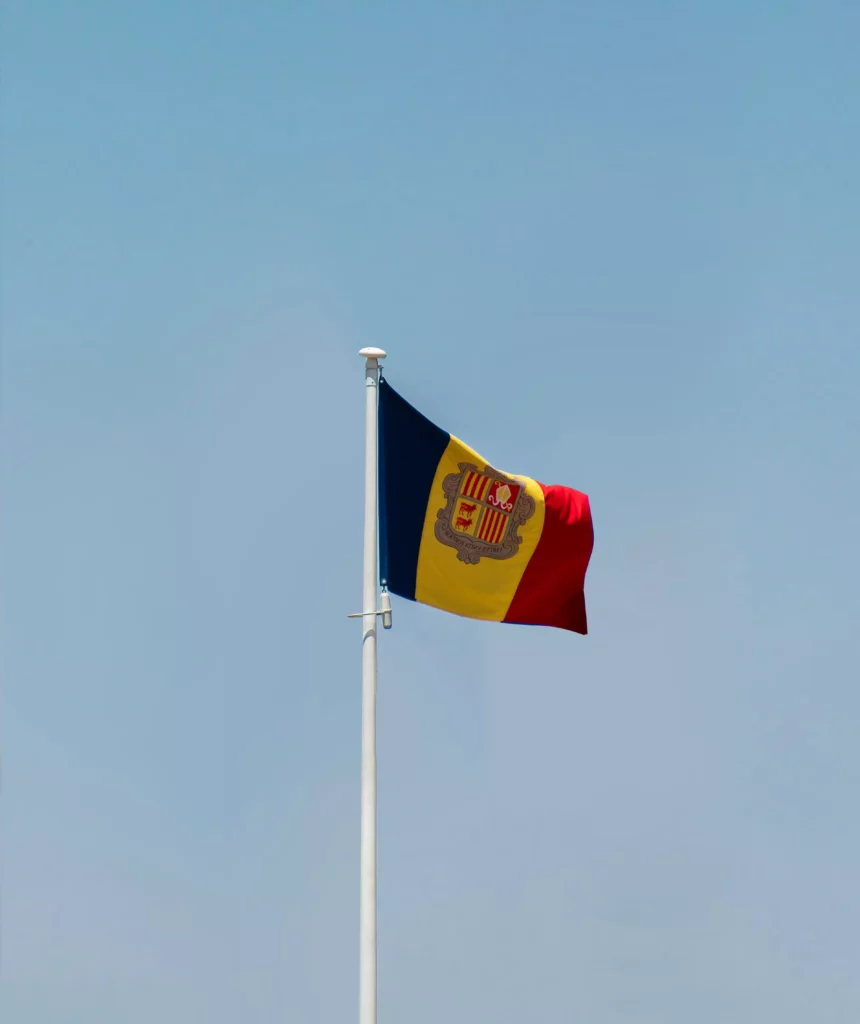
The flag of Andorra has three vertical stripes, blue, yellow and red, with the Principality’s coat of arms in the centre. It is one of the first images we associate with the country, although its details often raise more questions than answers: where its colours come from, what the symbols on the coat of arms represent and how long it has been in use.
If you are planning a visit, learning about the flag will help you see Andorra in context. Its history offers an introduction to a distinctive identity and historical ties that are not always easy to understand from the outside.
What the flag of Andorra looks like
The colours are read from the flagpole outwards: blue, yellow and red.
The coat of arms sits on the yellow stripe. This design makes the flag recognisable and distinguishes it from other tricolour flags.
To identify it, first look at the vertical orientation of the stripes, then at the central emblem. In a photograph taken from a distance, the colours catch your eye; up close, the coat of arms provides the historical clues.
The origins of the Andorran flag
The National Archives link the tricolour to 1866 and Napoleon III. They do not substantiate the supposed national flag of 1806.
It is worth distinguishing between the two emperors: Napoleon III is the figure associated with the birth of the tricolour. Attributing it simply to “Napoleon” obscures that distinction.
What its colours mean
The meaning of each colour is open to interpretation: the documentation does not establish a single official explanation.
For this reason, an explanation of the flag is more useful when it distinguishes between describing what we see and interpreting what it means. The colours are unmistakable; their symbolic meaning requires nuance.
Andorra’s coat of arms explained
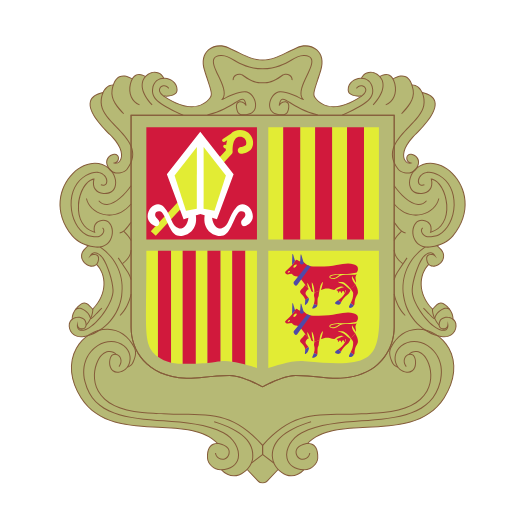
The coat of arms brings together the emblems of the Bishopric of Urgell, Catalonia, Foix and Béarn. The Latin motto Virtus Unita Fortior expresses the idea that united strength is greater.
It is a good starting point for exploring the country’s history: rather than trying to memorise all its details at once, start by recognising these four references. The coat of arms sums up historical relationships that also help explain Andorra’s distinctive institutional system.
Why different dates appear in its history
The birth of a symbol and its regulation do not always coincide. This timeline puts the main milestones in order:
| Date | Milestone |
|---|---|
| 1866 | Origin of the tricolour flag |
| 1942 | The General Council declares the three state symbols official |
| 1993 | The Constitution recognises the traditional symbols |
| 1996 | The law on state symbols sets out their protection and description in greater detail |
This explains why different accounts mention different years. A date is only useful if it is clear what happened then.
The flag and independence: a nuanced relationship
Andorra does not have a date of separation from Spain comparable to that of other modern states. To understand its development, it is helpful to distinguish the medieval origins of the co-principality from the Constitution of 1993. The flag tells part of that history; it does not replace it.
Was there a king of Andorra called Boris?

In 1934, Boris Skossyreff was at the centre of an episode involving a proclamation of monarchy. Known as Boris I, his story does not explain the origins of the tricolour. It is a separate historical curiosity that should be distinguished from the development of the national symbols.
Plan your visit to Andorra
Learning about the flag can be the first step towards discovering the culture of the Principality. If your journey takes you through Barcelona, you can book your DirectBus ticket as part of your planning.
If you make this journey frequently, take a look at the DirectBus multi-journey passes too, and check their conditions before choosing.


